

How It Started
At Aignostics, one of our core beliefs is that diversity, equity, and inclusion are not just the right thing to pursue, they are a key driver of success. The best science happens when the widest range of perspectives are in the room. So this year, for International Women’s Day, we wanted to celebrate and amplify the voices of our female colleagues. We sent a short survey to the women on our team, asking about their professional wins, their strengths, and the advice they'd give to other women in their field.
We expected stories to celebrate. What we found instead was a revealing glimpse into something more complicated. Many of the women who responded told us they almost hadn't – they weren’t sure if their experience was relevant enough, or if they had any good advice to give.
We'd set out to celebrate our colleagues' wins. What we found instead was a pattern researchers have been examining for decades: the gap between achievement and recognition, and why even asking women to share their successes can feel complicated. This has a name: imposter syndrome. So we scrapped the original post and wrote about that instead.
What the Research Says
We are scientists, after all. So naturally, we went looking for data.
A 2024 meta-analysis of 108 studies published in Current Research in Behavioral Sciences found that women consistently score higher on measures of imposter syndrome than men, and crucially, this gender gap has not narrowed over time, despite decades of progress in female representation in education and professional life. The phenomenon is not shrinking. If anything, it is evolving.
One example is documented in social psychology, what researchers call the "think manager, think male" phenomenon — both men and women tend to associate leadership qualities more strongly with masculinity. A woman who is confident and decisive in a meeting may be perceived as violating expected norms of warmth and communality. Another example is the Harold and Heidi experiment, in which students rated identical CVs differently based solely on whether the name was male or female. The person with the male name was seen as inspiring and easy to work with; the same CV with a female name was described as "hard to work with and selfish."
It is not just about external perception. Harvard Business School researcher Katherine Coffman has documented in controlled experiments that even when men and women have identical qualifications, women are statistically less likely to apply for promotions, particularly when criteria are ambiguous. But this confidence gap is not only internal. It is reinforced every time women receive mixed signals about whether their talent is truly recognized.
Before jumping to solutions, there's a reframe worth sitting with: imposter syndrome is not a mindset problem to be solved by individual effort alone. Treating it as a purely individual problem places the entire burden of change on the very people experiencing structural disadvantage. The data is clear—simply raising women's self-awareness doesn't change outcomes. The system has to change too.
What We're Doing About It
This survey experience caught us off guard — not because we believe we have a serious problem, but because we assumed a supportive culture was enough. It turns out, imposter syndrome doesn't disappear in a warm environment, it just goes quieter.
The science on effective interventions is still early, but some patterns are emerging: increased organizational support, empathetic leadership, and constructive peer feedback all seem to move the needle. We're now asking harder questions about whether the structures we already have are doing that work. Companywide praise channels and 360-degree feedback exist across Aignostics — but are those tools reaching everyone equally, or are the people most prone to self-doubt also the least likely to use them? And if self-promotion feels difficult, what if we invited colleagues to celebrate each other instead?
We're also thinking beyond our walls. Last year, Aignostics participated in Girls' Day, giving young women a glimpse into what a career in AI actually looks like. Seeing yourself reflected in a field is the first step toward believing you belong in it.
We don't have all the answers. But digging into the hesitation we observed turned out to be more revealing than a “smooth” survey would ever have achieved.
The Advice We Did Collect
The women who almost didn't respond had more to say than they realised. Their advice is proof that the voices most hesitant to speak up are often the ones most worth hearing.
Note: The following quotes were submitted specifically for publication in this post. Each contributor was given the option to remain anonymous and explicitly consented to having their name and words shared publicly.
"Don't underestimate yourself." — Evelyn, Senior Strategic Project Manager
"Trust your knowledge, education, and strengths — often people who are louder than you are just that: louder. Don't be afraid to show your ideas and be consistent about it. And find networks where you feel safe and supported." — Anna, Learning, Development & Culture Lead
"Build a network, keep your humour, learn to present data, fully understand the business and the people. Find coping mechanisms for when decisions are made that you don't agree with — I can recommend the sauna, particularly the hottest Aufguss. And always carve out time for something you love outside of work." — Nicole, Senior People Partner
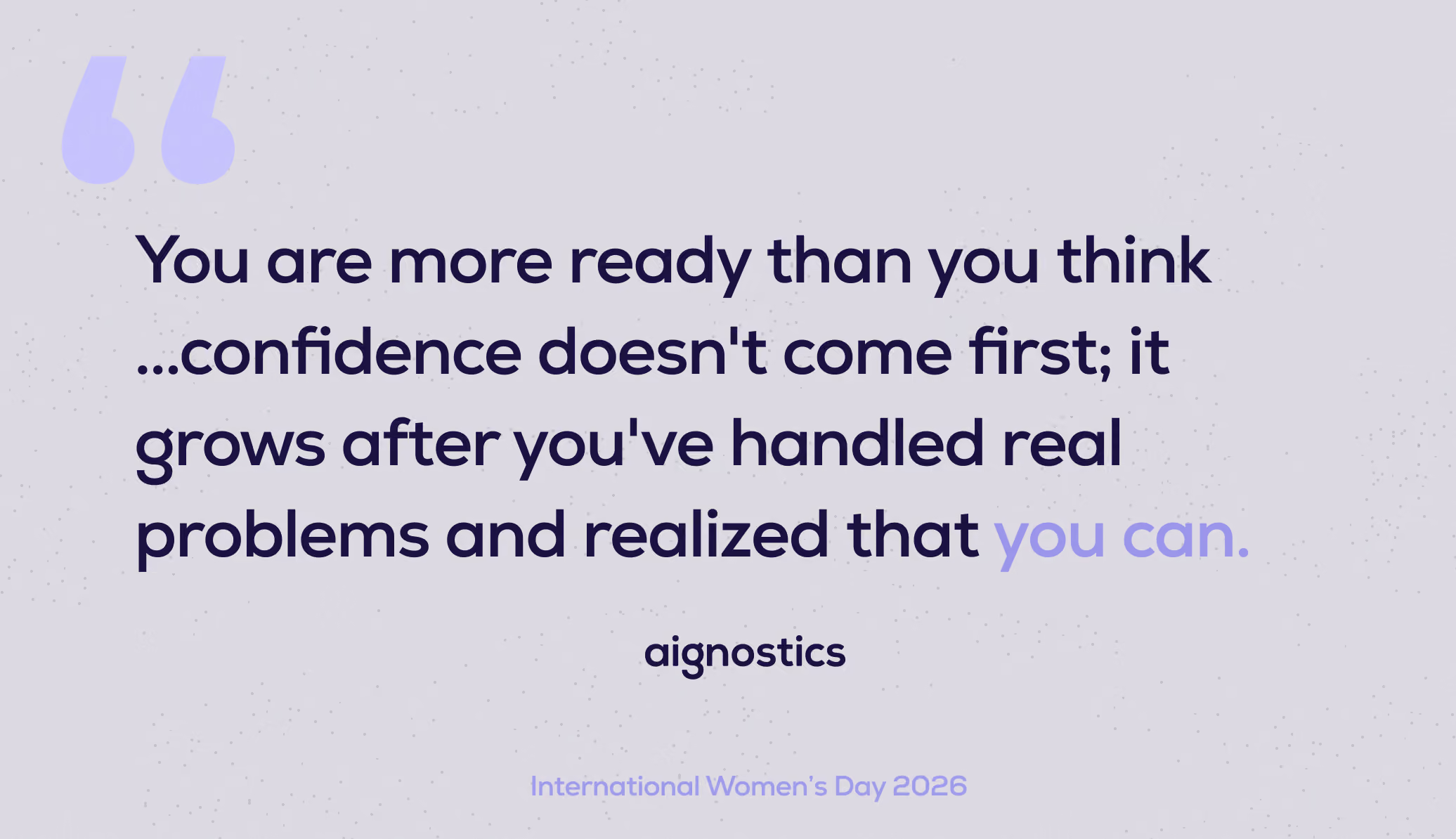
"You are more ready than you think you are. Many women in tech quietly hold themselves to a higher bar before speaking up or taking ownership, but you don't need to know everything to be valuable — nobody does. Confidence doesn't come first; it grows after you've handled real problems and realized that you can." — Marina, Staff Platform Engineer
"Find a work environment where you feel comfortable being yourself, where you are appreciated, and that fits your personal needs. And sometimes, this means realizing that a certain environment is not the right fit — and that you might shine much brighter somewhere else with the same skills." — Maria, Data Scientist
"Always remember to support and lift each other up." — Amelie, Machine Learning Engineer